

Contributed By Adrienne Boudreaux, Parent & Guest Teacher at Alta Heights Elementary School
At the start of the year, school day start and end times changed to provide teachers with much-needed preparation time. While this is a beneficial adjustment overall, it means they have a lot of curriculum to pack into the abbreviated schedule. Consequently, lunch/recess periods have been shortened and students have little time to explore freely. Students (and adults) are often being rushed from one activity to the next. Engaging the senses provides an opportunity to slow things down and the garden is the best place for this!
In Teaching in Nature’s Classroom, Nathan Larson highlights how engaging the senses can help “create rich memories that can support a lifelong affection for good food and time spent in nature.” This can also help children foster a sense of connection to the world around them.
Our first lesson in the garden this year combined SEL and sensory exploration together with wonderful results. For many of our Kinder and 1st grade students, this was their first time in the garden. There was so much for the students to observe and explore!
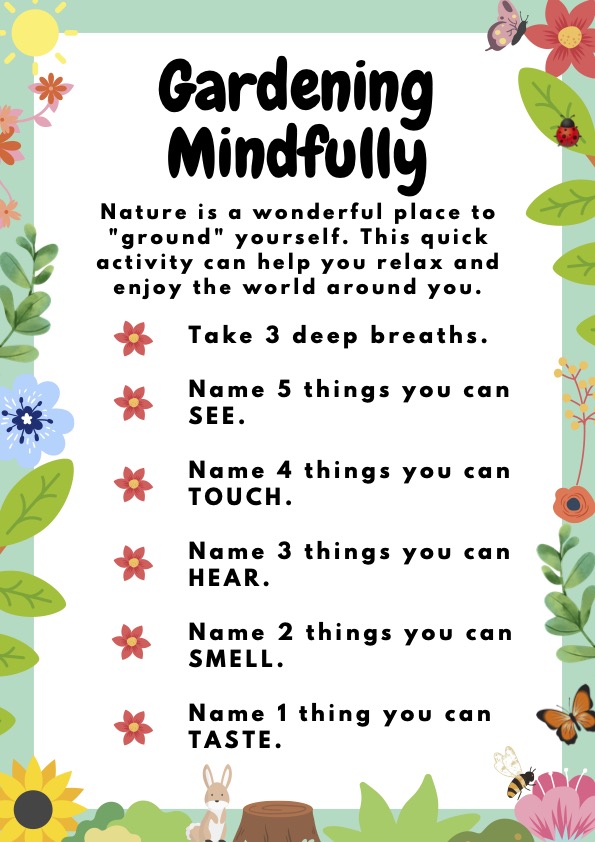
We started by sitting as a group and introducing our “grounding” activity. Students were instructed to take a few deep breaths to get ready to experience the garden with all their senses. We then did the common 5-4-3-2-1 technique to help relieve anxiety and stress, but with a twist. Students were encouraged to name 5 things they could see, 4 things they could touch, 3 things they could hear, 2 things they could smell, and 1 thing they could taste.
Instead of having students sit or stand in place, they were encouraged to engage with everything around them. What did they see in the sky, the soil, or under a stone? Did any plants have a strong smell? What did they hear in the garden, on the street, or on the nearby playground? Our kinders enjoyed yelling out to share with their classmates a cool bug they saw or piece of mint they smelled. Small hands dug into cool soil and shook seed envelopes. Boisterous exclamations rang from every corner of the space as students took it all in. With the older students, we came back together as a group to share, which also worked out well.
What did they see in the sky, the soil, or under a stone?What did they see in the sky, the soil, or under a stone? Did any plants have a strong smell? What did they hear in the garden, on the street, or on the nearby playground? Did any plants have a strong smell?
Since we did not have a spring/summer garden, we had to get a little creative with the “taste” part of the activity. Fortunately, I was able to bring in grapes for students to try. We talked about what grows during different seasons and how what we grow in our garden may taste or look different than fruits and veggies in the store.
All the students had a fantastic time, and it was exciting to see them begin to make those “rich memories” from their sensory exploration. At the end of the school day, a little boy brought his mom up to the fence to show her the garden. He was telling her all about our activity and passing along the things he saw, touched, heard, smelled, and tasted. Several others came up to me the following day and wanted to talk all about it.
Activities like exploring the garden with all 5 senses have strong evidence-based support for more than SEL. They also promote motor development, sensory integration. Mindfulness based activities also reduce stress and depression. Gardening offers endless ways to incorporate SEL opportunities into regular garden activities, while connecting kids with nature.
A well-rounded curriculum can help students develop the social-emotional skills necessary to be more successful when meeting stressful situations brought about by busy schedules, such as self-awareness. Instead of focusing on a constant forward movement and thinking ahead, it can be beneficial to make space for children to connect with themselves by being fully rooted in the present. Being outside in the garden is the perfect place to practice this!


Leave a reply to Core Principles Series: Cultivate a Sense of Wonder – Gleaning the Field Cancel reply