

Join Advocacy Day on April 9th!

Would you like to join Advocacy Day on April 9th? Napa School Gardens will sponsor your attendance ($55.20). Contact Carrie (carrie@schoolgardendoctor.org) to reserve your spot.
The Instructional School Garden Program (ISGP) was originally created in 1999 to integrate garden-based education into schools, but past funding was insufficient ($2,500 per school) and focused only on infrastructure rather than instruction and long-term program sustainability. As a result, half of California school districts have at least one school garden, around 9% are actively used to benefit kids through instruction.
The ISGP became inactive during the state budget crisis of 2008-09 and was shifted to an optional program during the COVID-19 pandemic. Those 9% of schools with active instructional garden programs overwhelmingly rely on parent and private fundraising in addition to one-time grants, with 72% of those districts located in higher-income districts. SB 341 addresses the disparity laying the groundwork for a sustainable funding model that will allow school districts to provide necessary staff/instructors and maintain garden spaces, creating learning environments that support academic growth, nutrition education, and student well-being for all students.
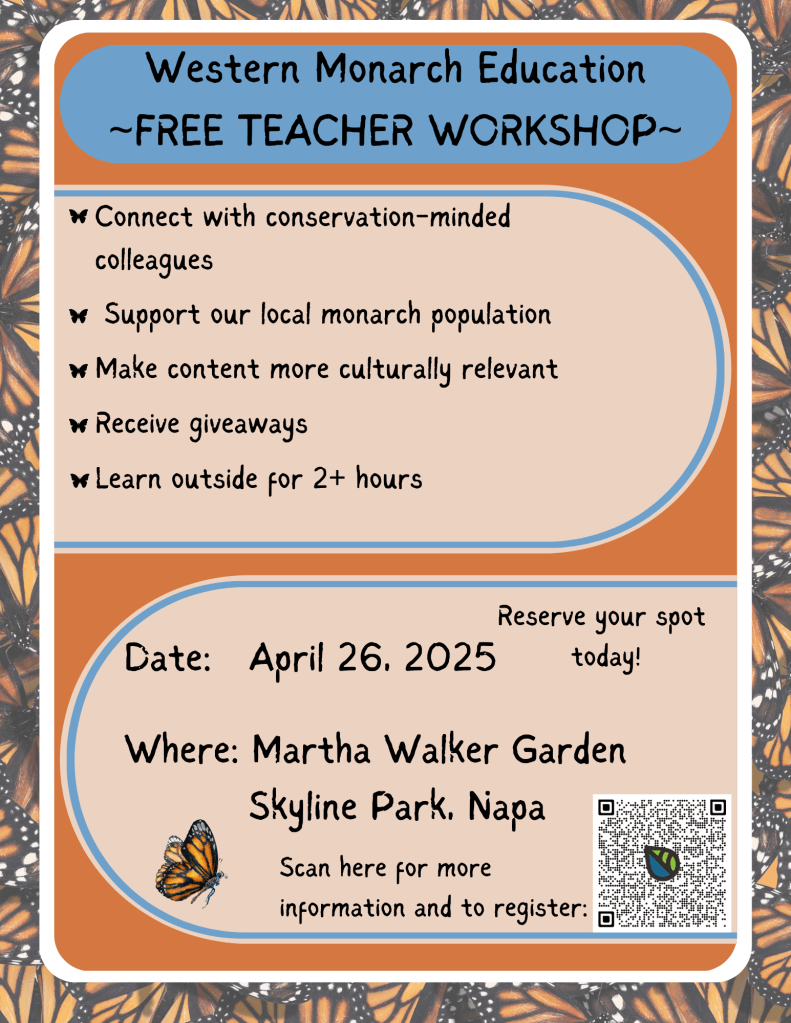
Napa RCD is offering a Teacher Workshop to expand the reach of the Kids for Monarchs program. This workshop is open to all educators but priority will be given to 1st and 2nd grade teachers.
Since 2022, Danielle has visited 38 classrooms, engaging 794 students in activities related to monarch conservation. RCD hopes to visit every first and second grade classroom in Napa County at least once.
Voices of Experience: Questioning the Questions
One of our newest Board Members, Wendy Fitzgerald, shares a delightful memory of an early gardening lesson she shared with her second grade students.
On a wintry afternoon in my primary grade classroom years ago, we began a new science unit with a series of questions I put to the budding scientists. They were open-ended questions about the life cycles of plants and trees, designed for us to discuss what we already knew, and what we still wanted to find out. After a short time, it was clear there was some commonly shared knowledge: seeds could grow into plants and trees, trees could produce fruit, both need sun, soil, and water.
Students had plenty of their own questions too, which we wrote down and posted for future discussions. Then I brought out some bean seeds. They were easy to see, fun to hold, and the excitement level went up dramatically inside the classroom. The most urgent questions were: “Where did I get them?” and “Where could we plant them?”
In those days, our school garden was not in good shape. It was a weedy strip of land between a parking lot and the street. I really wanted the evolution of the seeds to be very apparent to the students. The learning goal for them was to understand plant parts and their functions. I wanted to add more inquiry and analysis for a deeper understanding of the life cycle of a seed. We wrapped seeds in moist paper, placed them inside small clear plastic bags and taped them to the interior of our classroom windows.
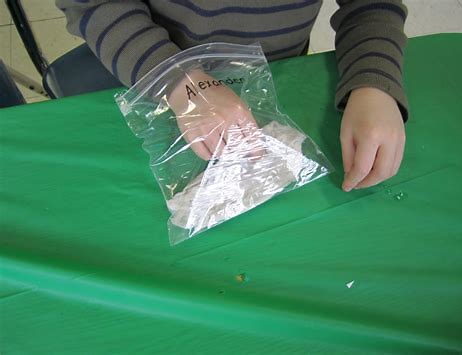
After a few days, we began to document the changes the students saw in the seeds. Students kept track of all kinds of observations: moisture in the bags, appearance of seeds, and the weather. We had an organizer for all of this data. They had plant journals where they wrote and drew. A few ideas we summarized: seeds are breaking open, a few seeds are growing something, some of the papers are wet and some are not so wet. More questions came out. One question in particular made me smile: When will we get to eat the beans?
Robert Marzano, a leading education researcher, is well-known for his distillation of 9 high-yield teaching strategies that help students attain deeper thinking in their units of study. Using questions, cues and advanced organizers is one of his strategies. I had designed this unit to include that strategy after trying it out several times in other parts of the curriculum. I had high expectations for the students and wanted the questions and the data collection to help them learn the life cycle of a seed to a plant that produces food.
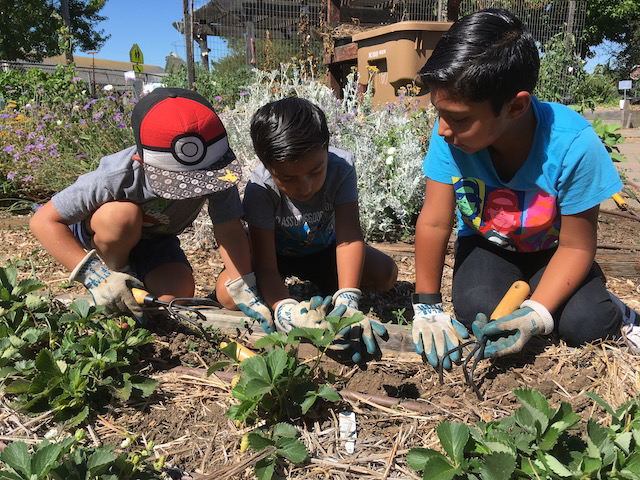
Days passed and the majority of the beans sprouted. It was time to give them the other part of what the students knew plants needed: soil. We transplanted the seeds into small containers filled with potting soil and continued to monitor them as the containers sat on the window sill. Each day the excitement grew as there were emerging sprouts and uncurling leaves. Students could measure the length of stems and wonder why some grew faster than others. Roots were visible. Much of this work got captured in their plant journals and on our chart.
The bean plants were climbing vigorously all over the window sill and had begun to flower. Since they needed more space to grow and we were approaching a spring break I decided it was time for the students to take home a bean plant if they wanted. We discussed how it would need a bigger container or a garden. And how the flowers would turn to beans. On dismissal that last day before spring break, almost all of them took a bean seedling with them.
One very proud little scientist showed the plant to his mom who was waiting at the door. He told her all he could summarize. Then he said, “But I can’t find the bean seed anymore. Mama, where is the seed?.” He began to dig around all the roots of the plant to find the seed. It was at that moment when I realized the point of the lesson had been lost. However, questions were still guiding his learning. The three of us talked. They took the plant home. I looked at the leftover ones in the classroom and knew we needed to get them into a garden.
I used to think… Now I think…is the summative sentence frame I find well-suited to reflective teaching: I used to think I asked good open ended questions to guide the learning. Now I think the students ask the questions that they need at the moment to make the learning relevant. Those moments are more likely to occur when students have rich, textured experiences–just the kind supported by school gardens.
About Wendy
Wendy brings more than two decades of service in public education, working with adult learners, and children of various ages. She spent many years teaching in a bilingual Spanish-English capacity. Gardens and the greater outdoors have always inspired her and she enjoys sharing that inspiration with people of all ages so that curiosity and dialog about nature can be learning experiences in and around our communities.
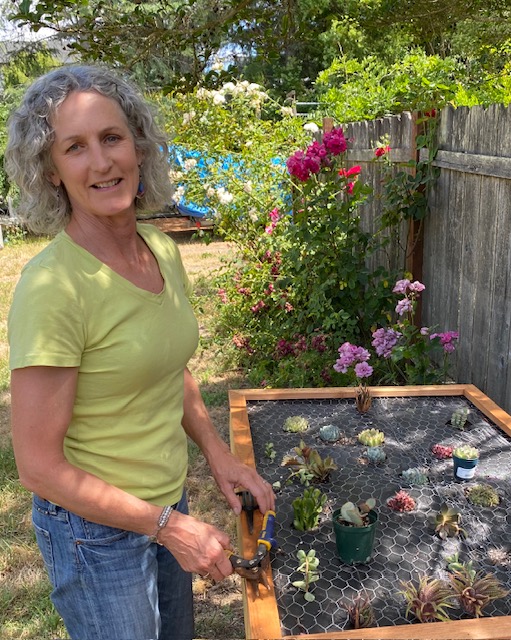
Nominations for the Erin S. Soper Memorial Award opened on March 4th. Established in 2022, this award distributes $500 stipends to teachers who sustain thriving school gardens. Nominate someone today.
Spring is such an exciting time in the garden. The first flowers begin to bloom, early seeds can be sown directly outside, and there’s always weeding to do. Check out the Garden Enhanced Nutrition Education planting calendar here.
New to Napa School Gardens? Introduce yourself in the comments below or subscribe to this quarterly newsletter.

Leave a comment