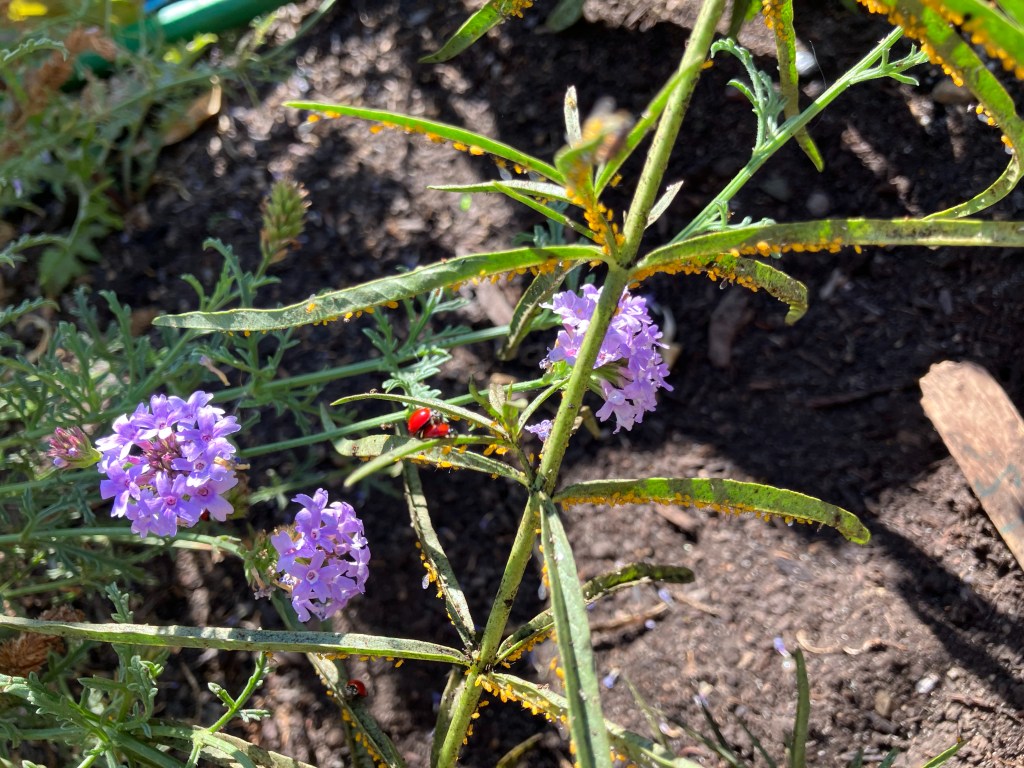

It’s time to let the garden rest. Spend the winter break perusing seed catalogs and dreaming up a spring harvest. You can consult the planting calendar here.
Opportunity: Call for Board Members!
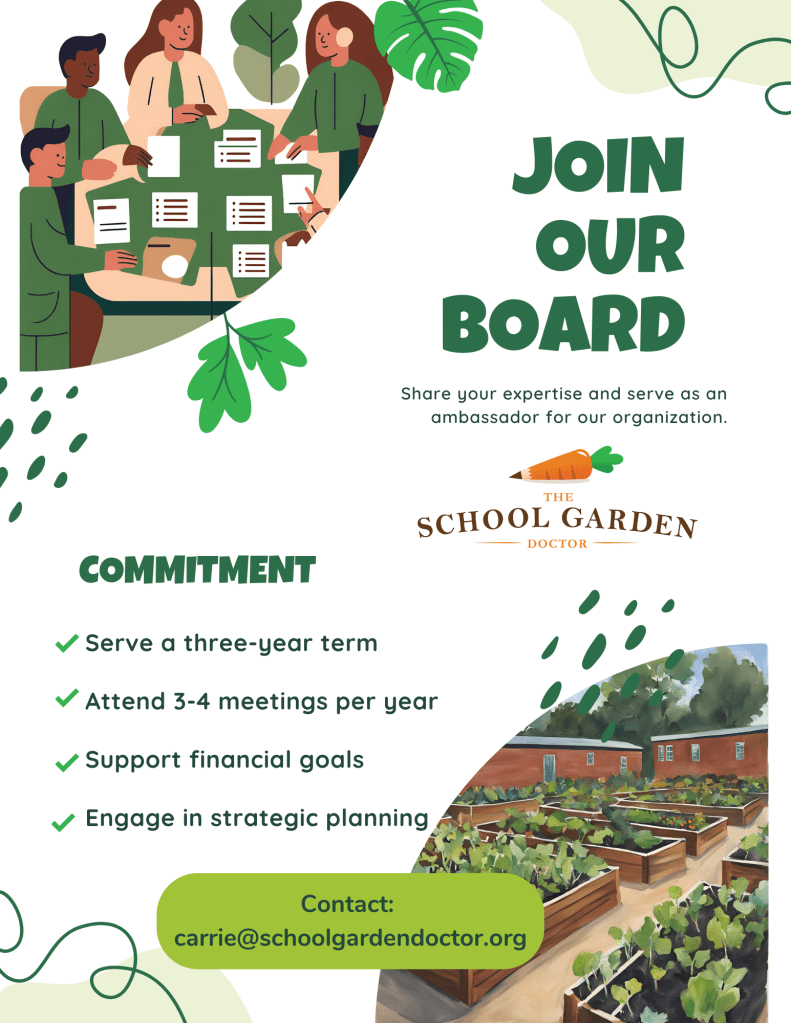
Are you looking to ‘level up’ your contribution to the school garden movement? The School Garden Doctor is recruiting Board Members for the 2025-2028 term. Wondering what a Board of Directors does? Here are some of the things the last board accomplished between 2021 and 2024:
- Hosted 2 informal gatherings for educators.
- Established the Erin Soper Award and distributed $3,500.
- Authored two dozen blog posts or newsletters.
- Distributed 100 Clarkia spp. plants to the community.
- Engaged 15 youth in planting a 200-square foot Monarch Waystation, the first in Napa County to register with Monarch Watch.
- Wrote (and received) a $3,000 Whole Kids Foundation Grant with a Community Partner site.
- Tabled at four community events to share the benefits of school gardens with the public.
- Partnered with three nonprofit organizations to evaluate their programs or initiatives.
- Coached 15 teachers to implement environmentally-focused science instruction.
- Raised $15,000 in donations from the community.
Voices of Experience
Carrie Strohl, Founding Board Member of The School Garden Doctor, shares how to plant a Monarch Waystation.
In Collaborating to Support Monarchs (Dirt Girls Diary, May 2024), I shared the story of several community-based organizations working together to install a Monarch Waystation in a local school. Although it was fairly ‘easy’ to implement because I was working with such incredible partners, it required a fair amount of background and resources. As we prepare to replicate our efforts, I thought I’d revisit how we made it happen.
Follow the Most Current Science. Before embarking on any conservation effort, it’s important to update your scientific knowledge base. Monarch life cycle and migration were not new topics for me, however it had been a few years since I wrote On Monarchs, Milkweed, and Memorable Experiences in the School Garden. I felt I needed a refresher. Thankfully, monarch information is abundant these days! I started by attending a talk hosted at The Watershed Nursery in Richmond, CA. The presenter shared current statistics about monarch decline and ended with a call to action: join the community science effort. Anyone in the school garden world knows experience is the best teacher, so to further extend my learning, I signed up to participate in the Western Monarch Count.
Engage Community Partners. I was joined by two additional monarch educators: a board member of The School Garden Doctor and the elementary lead for Napa County Resource Conservation District youth programs. We attended a field training at St. Peter’s Chapel on Mare Island, just 15 miles south of us. Little did I know that there is are three overwintering sites in neighboring Solano County!* We met other nonprofit leaders and conservation educators at the field training. This included representatives from Solano County RCD, who had already developed several very practical tools for creating monarch habitat. Luckily, we had a planned site for the Waystation, so I was sure to share important lessons with the site garden educator.
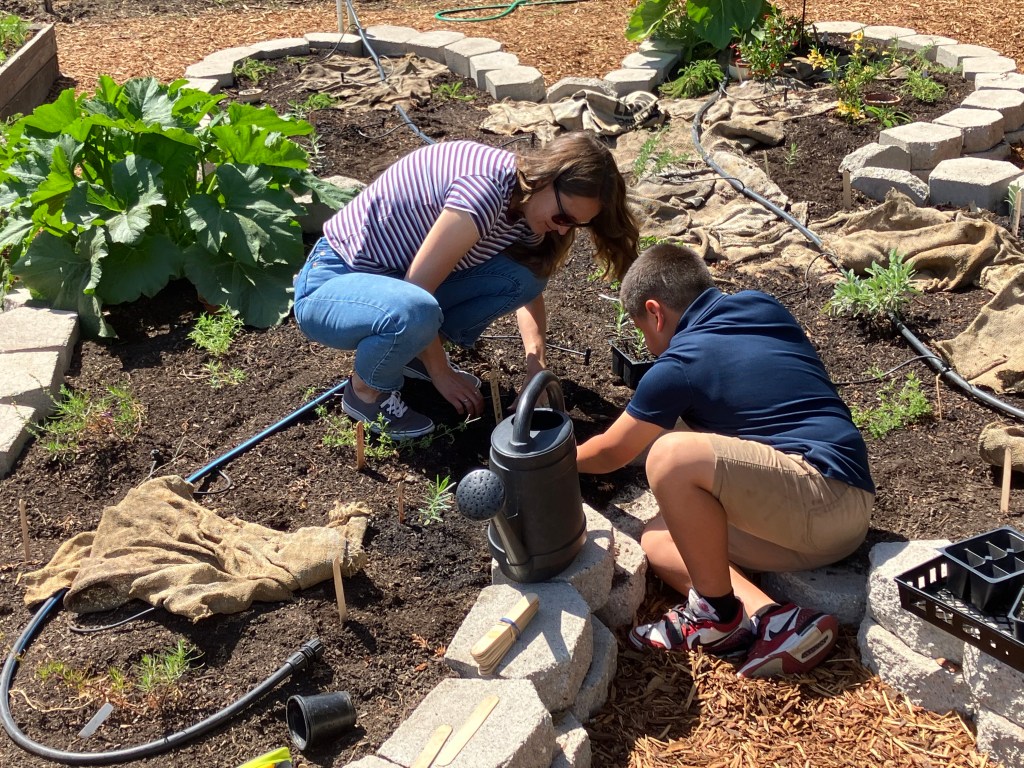
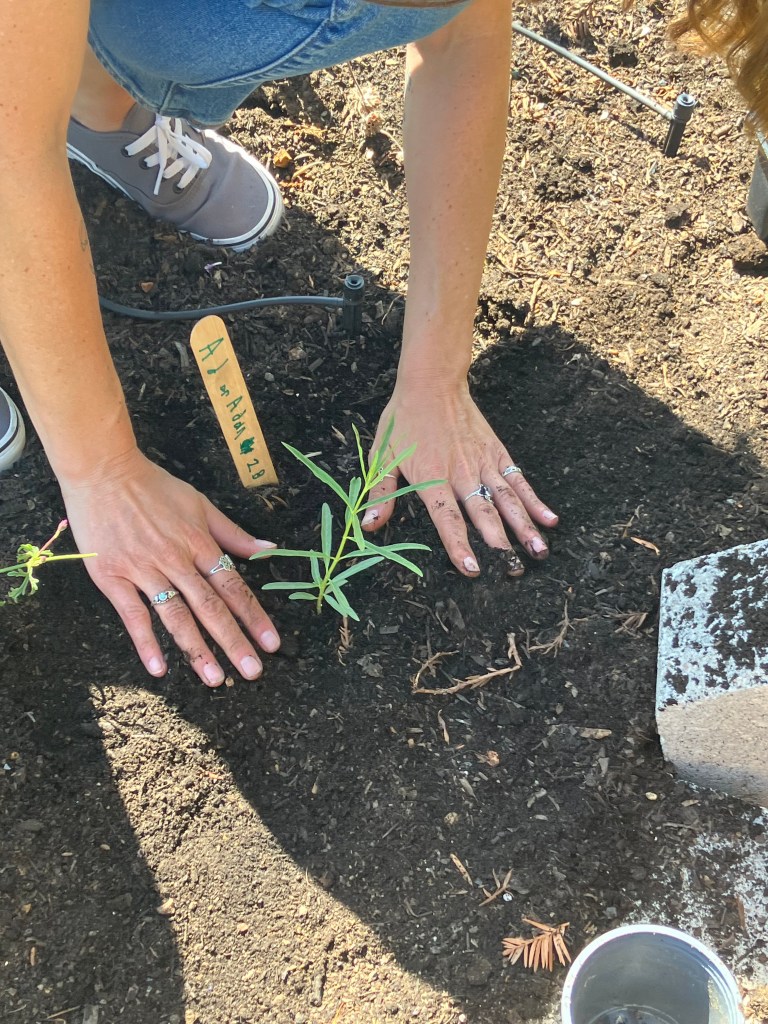
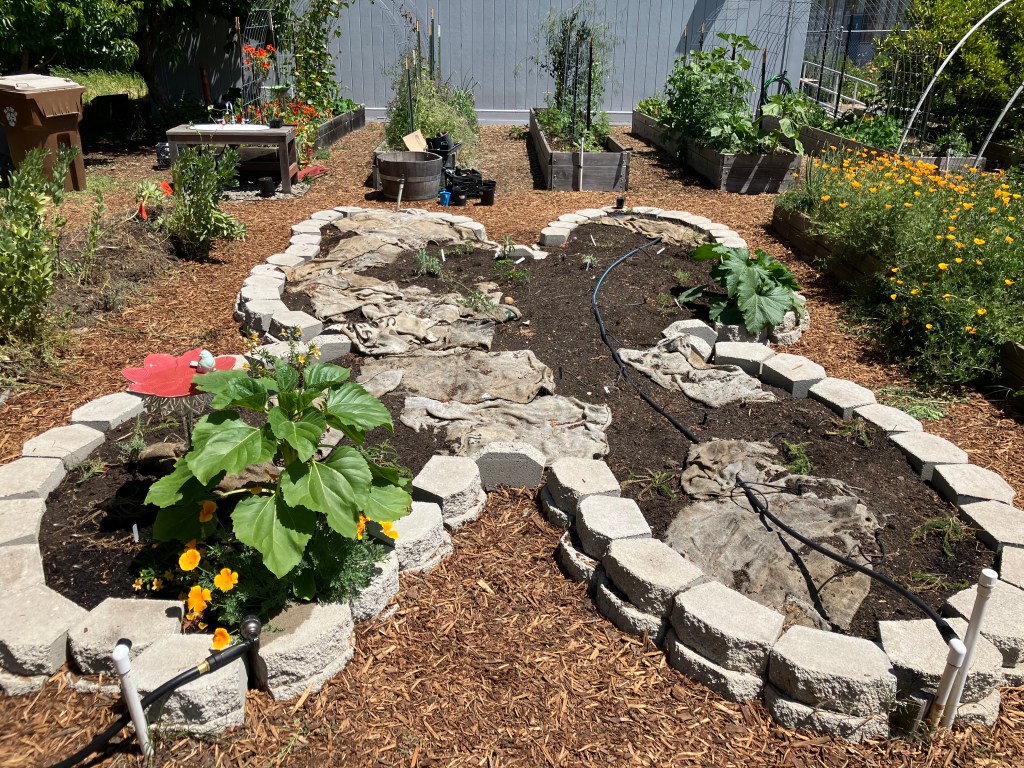
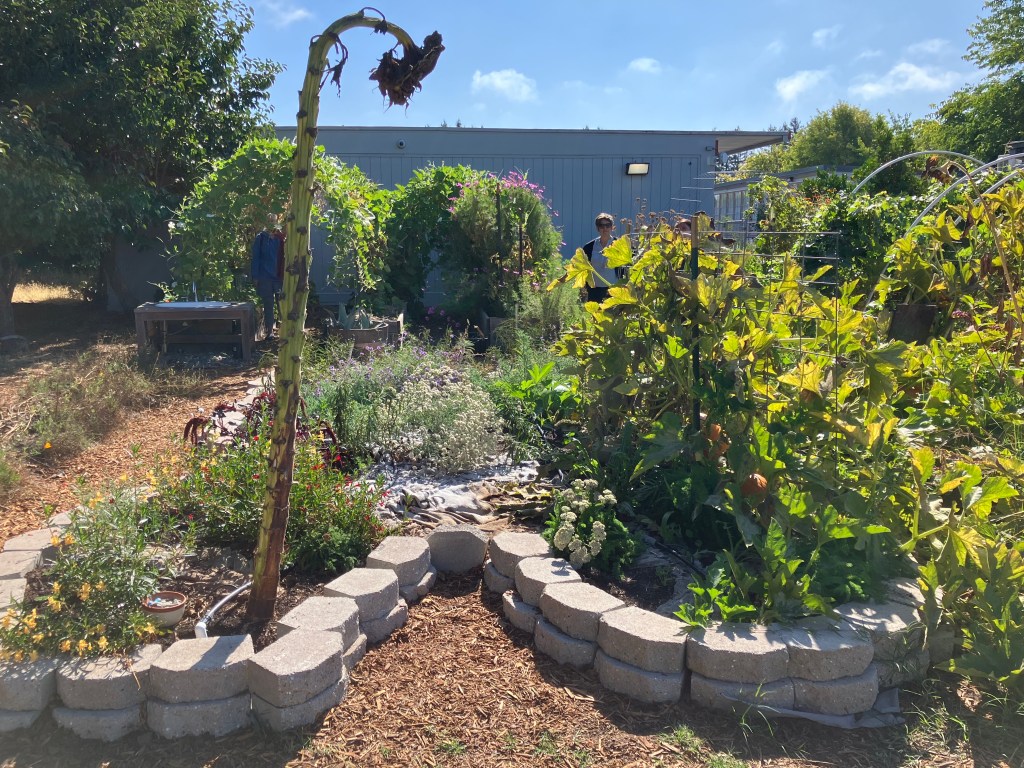
Secure Resources. With a site and community support, we secured resources like plants and infrastructure. Thanks to our Napa RCD connection to the Western Monarch Society, we received a donation of 18 milkweed plants. Our local chapter of the California Native Plant Society also donated a flat of flowering nectar plants. The parent club of the school invested a lot of time and energy in preparing the site. They purchased landscape bricks to replace two of the raised beds that were falling apart. Over a few weekend work days, parent volunteers shaped the bricks into a butterfly. Although our design was much more kid-guided, we did plant the milkweed last–and on the perimeter, as recommended by Solano RCD planting plans. Whatever design you choose, it’s important to have nectar plants that bloom throughout the seasons that monarchs are migrating. In California, that is typically early spring (as they leave the overwintering sites) and late summer (mid-September) when they make their way back.
Involve Students. Our space was not that large (about 200 square feet), so it would have been fairly easy to get the whole thing planted in a single day, especially with those hardworking volunteers! However, we opted instead to have students do the important planting tasks. Over a six-week period, we guided about a dozen students in an after school club to get our plants in the ground. Each week, students checked on the plants and took care of the watering needs. Students also built puddling stations–shallow dishes filled with sand for sipping water and minerals. Now that our Waystation is planted, we’re integrating it into the garden and classroom lessons.
Connect Curriculum. One of the reasons Napa RCD was such a willing partner is that they have a mandated directive to take steps to conserve land for monarch habitat. Although they have resources to support planting on Ag Land, they have fewer resources for classroom education. Through our partnership, we can focus our collective resources for maximum impact. This fall, second grade classrooms participated in a monarch journey activity and next spring first grade classes will learn about the monarch life cycle. Why first and second grades? These grades connect particularly well to the Next Generation Science Standards. Monarch butterflies make a great phenomenon to teach “patterns in behavior of parents and offspring that help offspring survive” (1-LS1-2) and “make observations of plants and animals to compare the diversity of life in different habitats” (2-LS4-1).
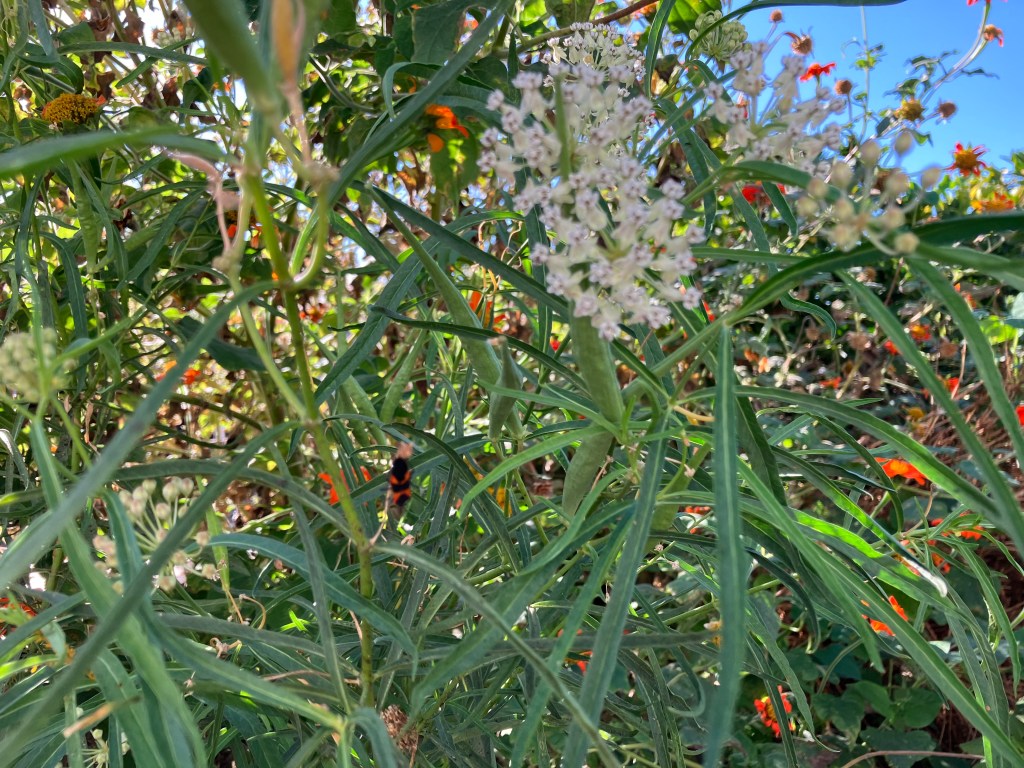
Share the Wonder. As soon as our partner site ‘named’ their garden, we registered the Waystation with Monarch Watch. Corazón Monarca was waystation number 49,500! Six months later, the Monarch Waystation is thriving! There is a volunteer pumpkin obscuring the shape of the brick butterfly over the summer, but was harvested in November. The narrow-leaf milkweed was flowering and/or going to seed in September and October. A healthy colony of aphids attracted ladybugs to complete their life cycle in our patch. We’ve seen a few butterflies, but no eggs or larvae yet. Maybe next year.
*There are three documented monarch overwintering sites in Solano County: one on Mare Island (St. Peter’s Chapel/Chapel Park, another in South Vallejo (Behind Harbor Park Apartments, west of the Norman C King Community Center), and a third in Fairfield (immediately east of 1690 West Texas Street in a row of eucalyptus trees).
Monarch Resources
- CA Nectar Plants
- Embracing a Place-Based Approach in the School Garden
- Monarch Watch: Milkweed Market
- Priority Action Zones in CA for Recovering Western Monarchs
- Western Monarch Count
In January, The School Garden Doctor is planning a visit to the overwintering site on Mare Island in Vallejo. If you are interested in learning more, let them know here.
Carrie spent a year as a garden educator before delving into the research of school gardens. As a UC Master Gardener, she started the School Garden Task Force, which later merged with the Napa Valley School Garden Network to become Napa School Gardens. She has written extensively about school gardens on the blog Gleaning the Field.
Does your site have a garden committee?
Leave a comment below or send us your thoughts here and receive a FREE Copy of the School Garden Curriculum by Kaci Rae Christopher.
New to Napa School Gardens? Introduce yourself below.

Leave a comment