
Seasonal News to Grow On
Cold and rainy weather can curb outdoor exploration and work in the garden. With this lesson from Growing Young Minds, students make signs that are both informative and beautiful.
Recognize the signs in these pictures? Use the link below to claim/name them and you will be sent a salsa or pollinator seed pack.

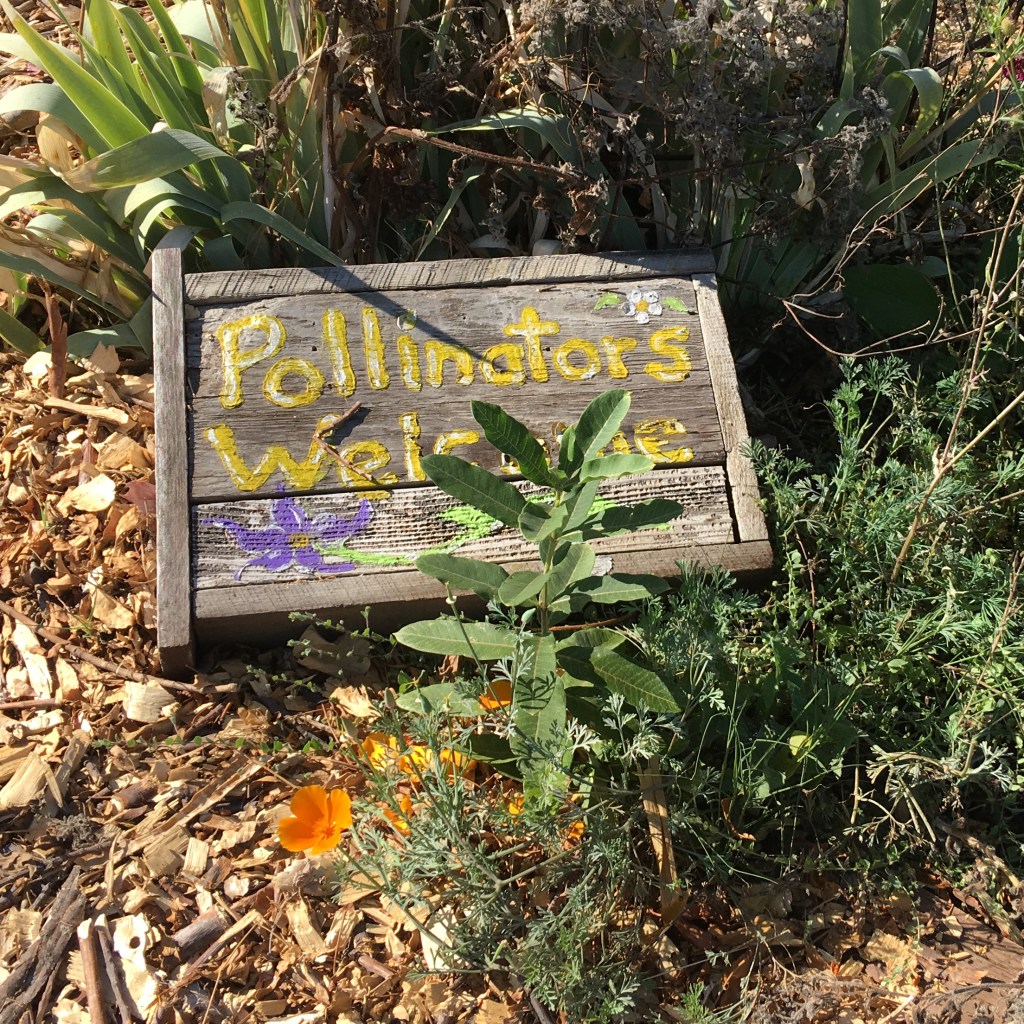
**Share your garden sign ideas and stories here.**
Upcoming Events

Voices of Experience:
Children are the heart of a school garden
By Louann Talbert, who has 30 years experience of developing, teaching, working and volunteering in school gardens.
First and foremost, school gardens should be physical places and spaces for, with and by children. If you visualize a concept-map of a school garden, children should be the center that everything else branches off from. Schools are places of learning and there is so much to be learned outside the walls of an indoor classroom. Travel can be the best education, but children can explore so much with growing things whether traveling over to a pot on a window sill, barrels outside a classroom door or an acre of land with vegetable beds, fruit trees, seating areas, farm animals and wildlife. Every subject can be taught/enhanced in a garden. Poetry-writing, singing, agricultural history, geometry, painting, botany, earth science, chemistry; there is no end to it! I have taught almost all middle school science standards (atomic structure, Periodic Table of Elements, botany, ecology, evolution . . .) through a school garden. My students loved to learn that way and almost all said “we need to spend more time in the garden!”
Be sure to include students in the initial planning for a school garden. At any age, children can be guided through this process. So much is to be learned about earth and celestial movements, weather, climate, botany and community in planning the location and layout/infrastructure of a garden. I have pictures of the huge smiles on my students’ faces, documenting the pride they had in creating our garden design and doing the actual building of our raised beds (with lots of adult supervision, of course!). Don’t leave children out of these first steps, including research, discussion, collaboration (with local experts) and presentation skills!
When any person is involved meaningfully in the creation of anything, so many wonderful experiences and feelings are developed. These include self-value, purpose, ownership, responsibility, work ethic, care and love. This is very true for children and school gardens. Students feel so proud and valued when they work together with each other and adults to create a beautiful outdoor space. On the other hand, if a garden is conceived and created by adults and “handed” to children, it is much harder for them to benefit from it. I have seen school gardens that are conceived and totally managed by adults only and the disconnect for students is palpable.
Children have incredibly open, creative minds – they have much to share in the creation of school gardens. And all children can do physical work in some way to help build and maintain a garden. Students can also develop their own sensible guidelines for outdoor behavior and follow those guidelines, with a teacher’s direction. Finally, children should be the main participants in choosing what to plant, and the planting, maintenance, harvesting, eating, seed-collecting and composting of every plant in a school garden. It is a very forgiving place to try, experiment, fail and try again.
December, 2023
In case you missed it…
September’s Post
Seasonal News: Spring 2026
Nominations for the Erin S. Soper Award are due April 4th, recognizing community contributions to school gardens and sustainability.
Keep reading
Something went wrong. Please refresh the page and/or try again.
Local stories to sustain school gardens.

Leave a comment